Friday, February 12, 2010

single replacement


In a single replacement reaction, or single displacement reaction, a single uncombined element replaces another in a compound. Two reactants yield two products. For example when zinc combines with hydrochloric acid, the zinc replaces hydrogen. The chemical equation for this single replacement reaction looks like:

Zn + 2HCl ---> ZnCl2 + H2

Some other examples are:

Cu + AgNO3 ---> Ag + Cu(NO3)2

Fe + Cu(NO3)2 ---> Fe(NO3)2 + Cu

Ca + H2O ---> Ca(OH)2 + H2

Decomposition


Decomposition or rotting is the process by which tissues of a dead organism break down into simpler forms of matter. The process is essential for new growth and development of living organisms because it recycles the finite matter that occupies physical space in the biome. Bodies of living organisms begin to decompose shortly after death. It is a cascade of processes that go through distinct phases. It may be categorised in two stages by the types of end products. The first stage is characterized by the formation of liquid materials; flesh or plant matter begin to decompose. The second stage is limited to the production of vapors. The science which studies such decomposition generally is called taphonomy from the Greek word taphos, which means grave. Besides the two stages mentioned above, historically the progression of decomposition of the flesh of dead organisms has been viewed also as four phases:

1. fresh (autolysis),
2. bloat (putrefaction),
3. decay (putrefaction and carnivores) and
4. dry (diagenesis).

combustion


Combustion or burning is the sequence of exothermic chemical reactions between a fuel and an oxidant accompanied by the production of heat and conversion of chemical species. The release of heat can result in the production of light in the form of either glowing or a flame. Fuels of interest often include organic compounds (especially hydrocarbon) in the gas, liquid or solid phase.

In a complete combustion reaction, a compound reacts with an oxidizing element, such as oxygen or fluorine, and the products are compounds of each element in the fuel with the oxidizing element. For example:

CH4 + 2O2 → CO2 + 2H2O + energy
CH2S + 6F2 → CF4 + 2HF + SF6

balancing equations


When a chemical reaction occurs, it can be described by an equation. This shows the chemicals that react (called the reactants) on the left-hand side, and the chemicals that they produce (called the products) on the right-hand side. The chemicals can be represented by their names or by their chemical symbols.

Unlike mathematical equations, the two sides are separated by an arrow, that indicates that the reactants form the products and not the other way round.


In this tutorial you will see plenty of chemical equations, both using the names of the chemicals and also their symbols. There is also an exercise at the end if you want to try your hand at balancing chemical equations!


A large number of chemical equations are more complicated than the simple ones you will see in this section. They are reversible, which means that the reactants react together to form the products, but as soon as the products are formed, they start to react together to reform the reactants!

Reversible equations proceed in both directions at once, with reactants forming products and products forming reactants simultaneously. Eventually, the system settles down and a balance (an equilibrium) is reached, with the reactants and products present in stable concentrations. This does not mean that the reaction stops, merely that it proceeds in both directions at the same rate, so that the concentrations do not change.
converting grams to moles


You must first find the molar mass of the element or compound. Use the periodic table (see the Related Link). If the chemical is an element, just read off the atomic mass from the periodic table. If it is a compound, you must know the molecular formula, and then you find the total molar mass of the compound by adding up the atomic masses of each atom in the compound. The unit of the molar mass will be in grams per moles (g/mole).
Once you have the molar mass, you can easily convert from grams to moles, and also from moles to grams.
Number of moles = (# of grams) ÷ (molar mass)
Number of grams = (# of moles) × (molar mass)

Thursday, January 7, 2010

Like Dissolves Like

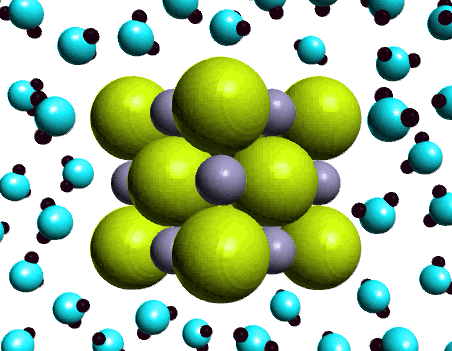
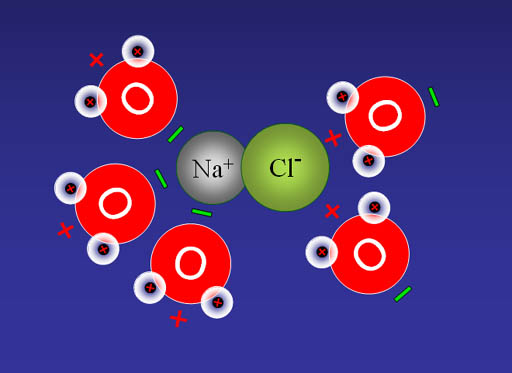
In the right conditions, when solid particles meet liquid particles they can mix together to form a special mixture called a solution. This process is called dissolving. When they do dissolve, the solid part is called the solute and the liquid it dissolves in is called the solvent.


Here is a link that shows a video on dissolving solvents and solutes. http://www.northland.cc.mn.us/biology/BIOLOGY1111/animations/dissolve.html
"Like dissolves like" is an expression used by chemists to remember how some solvents work. It refers to "polar" and "nonpolar" solvents and solutes.

Like Dissolves Like

:(

Followers